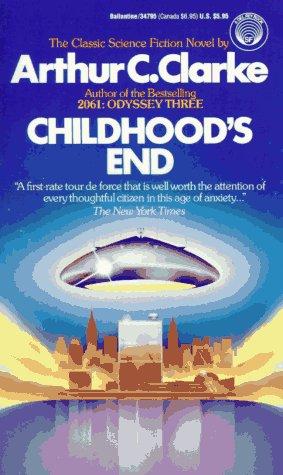
Childhood's End is a 1953 science fiction novel by the British author Arthur C. Clarke. The story follows the peaceful alien invasion of Earth by the mysterious Overlords, whose arrival begins decades of apparent utopia under indirect alien rule, at the cost of human identity and culture. Clarke's idea for the book began with his short story "Guardian Angel" (published in New Worlds #8, winter 1950), which he expanded into a novel in 1952, incorporating it as the first part of the book, "Earth and the Overlords". Completed and published …
Childhood's End is a 1953 science fiction novel by the British author Arthur C. Clarke. The story follows the peaceful alien invasion of Earth by the mysterious Overlords, whose arrival begins decades of apparent utopia under indirect alien rule, at the cost of human identity and culture.
Clarke's idea for the book began with his short story "Guardian Angel" (published in New Worlds #8, winter 1950), which he expanded into a novel in 1952, incorporating it as the first part of the book, "Earth and the Overlords". Completed and published in 1953, Childhood's End sold out its first printing, received good reviews and became Clarke's first successful novel. The book is often regarded by both readers and critics as Clarke's best novel and is described as "a classic of alien literature". Along with The Songs of Distant Earth (1986), Clarke considered Childhood's End to be one of his favourites of his own novels. The novel was nominated for the Retro Hugo Award for Best Novel in 2004.
Several attempts to adapt the novel into a film or miniseries have been made with varying levels of success. Director Stanley Kubrick expressed interest in the 1960s, but collaborated with Clarke on 2001: A Space Odyssey (1968) instead. The novel's theme of transcendent evolution also appears in Clarke's Space Odyssey series. In 1997, the BBC produced a two-hour radio dramatization of Childhood's End that was adapted by Tony Mulholland. The Syfy Channel produced a three-part, four-hour television miniseries of Childhood's End, which was broadcast on December 14–16, 2015.
Review of "Childhood's End (Arthur C. Clarke Collection)" on 'Goodreads'
5.0 stars
This is an absolutely outstanding, albeit disturbing, tale of the future. It is simply amazing that it was written in the 1950s. I place it in a category of must read science fiction.
Written in 1953 and covering Clarke's ideas of modernity and social philosophy, it was interesting to compare reality with the fictional predictions of how to create utopia. Two moments stood out: the invention of birth control and paternity testing leading to the end of "Puritan aberration"; and while he claims, " Evil men could be destroyed, but nothing could be done with good men who were deluded," he doesn't seem to apply this to systems-thinking. So, there's a lot of racism and patriarchy in a book that is trying to write those things out of fictional existence. I imagine Escher's flawed hand drawing the flawed human. He also had a character outraged at the THREE whole hours of radio/TV consuming people's minds, and how this was a blight on humanity's creativity and thinking. That one he seems to have nailed pretty spot-on. His solution for it was odd, and left …
Written in 1953 and covering Clarke's ideas of modernity and social philosophy, it was interesting to compare reality with the fictional predictions of how to create utopia.
Two moments stood out: the invention of birth control and paternity testing leading to the end of "Puritan aberration"; and while he claims, " Evil men could be destroyed, but nothing could be done with good men who were deluded," he doesn't seem to apply this to systems-thinking. So, there's a lot of racism and patriarchy in a book that is trying to write those things out of fictional existence. I imagine Escher's flawed hand drawing the flawed human.
He also had a character outraged at the THREE whole hours of radio/TV consuming people's minds, and how this was a blight on humanity's creativity and thinking. That one he seems to have nailed pretty spot-on. His solution for it was odd, and left out women completely.
He kind of glosses over UBI or work-related issues. I suppose that was necessary to keep the focus on the plot, but it's a pretty huge handwavium for a utopia. I would have preferred to hear more about those things, and less about the flying transportation. There was a lot in the travel parts that I found silly. Did they not have international travel in 1953? [they did: 1945] It certainly hasn't cured any societal ills.
As far as the actual plot of the book goes - meh. The aliens were a fun surprise, but beyond that I found it kinda dull.