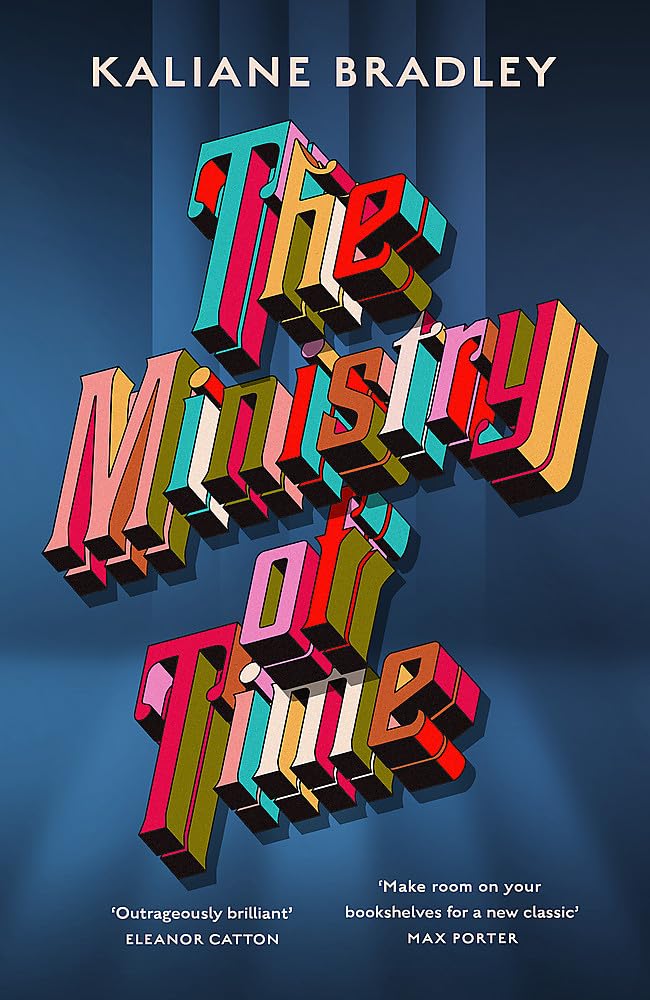
In the near future, a civil servant is offered the salary of her dreams and is, shortly afterward, told what project she’ll be working on. A recently established government ministry is gathering “expats” from across history to establish whether time travel is feasible—for the body, but also for the fabric of space-time.
She is tasked with working as a “bridge”: living with, assisting, and monitoring the expat known as “1847” or Commander Graham Gore. As far as history is concerned, Commander Gore died on Sir John Franklin’s doomed 1845 …
In the near future, a civil servant is offered the salary of her dreams and is, shortly afterward, told what project she’ll be working on. A recently established government ministry is gathering “expats” from across history to establish whether time travel is feasible—for the body, but also for the fabric of space-time.
She is tasked with working as a “bridge”: living with, assisting, and monitoring the expat known as “1847” or Commander Graham Gore. As far as history is concerned, Commander Gore died on Sir John Franklin’s doomed 1845 expedition to the Arctic, so he’s a little disoriented to be living with an unmarried woman who regularly shows her calves, surrounded by outlandish concepts such as “washing machine,” “Spotify,” and “the collapse of the British Empire.” But he adjusts quickly; he is, after all, an explorer by trade. Soon, what the bridge initially thought would be, at best, a seriously uncomfortable housemate dynamic, evolves into something much more. Over the course of an unprecedented year, Gore and the bridge fall haphazardly, fervently in love, with consequences they never could have imagined.
Supported by a chaotic and charming cast of characters—including a 17th-century cinephile who can’t get enough of Tinder, a painfully shy World War I captain, and a former spy with an ever-changing series of cosmetic surgery alterations and a belligerent attitude to HR—the bridge will be forced to confront the past that shaped her choices, and the choices that will shape the future.
An exquisitely original and feverishly fun fusion of genres and ideas, The Ministry of Time asks the universal What happens if you put a disaffected millennial and a Victorian polar explorer in a house together?
I'm usually a contrarian reader about books that show up on a lot of media "best of" lists, but I thoroughly enjoyed The Ministry of Time. The story warns about the consequences of climate change in a very subtle and un-preachy manner. I wasn't wild about the romance aspect - maybe I'm too old, but the sex scenes are more detailed than I'm looking for in fiction. Otherwise, I found this a highly entertaining blend of spy stories and s-f.
I liked parts of the book. In places, however, I felt the book was not thought through to the end. And for me there were too many stylistic breaks in the main character's text passages as well as blocks were things seemed to be missing in her train of thoughts. I also felt that the change in her moods was not well described stylistically, but seemed more like something that was put in to emphasize her character but was not done in a progressively well done way. The course of the plot itself was also not sufficiently logically explained to me in some places, but seemed erratic.
In general, I felt that the written portrayal of the main character and her emotional actions and reactions, which were strongly based on (supposed) logic, and her rationalized, sometimes fashistiod attitude and decisions were well portrayed. However, …
It's rather 2.5 stars.
I liked parts of the book. In places, however, I felt the book was not thought through to the end. And for me there were too many stylistic breaks in the main character's text passages as well as blocks were things seemed to be missing in her train of thoughts. I also felt that the change in her moods was not well described stylistically, but seemed more like something that was put in to emphasize her character but was not done in a progressively well done way. The course of the plot itself was also not sufficiently logically explained to me in some places, but seemed erratic.
In general, I felt that the written portrayal of the main character and her emotional actions and reactions, which were strongly based on (supposed) logic, and her rationalized, sometimes fashistiod attitude and decisions were well portrayed. However, her room for maneuver or lack of maneuver due to her strong self-centeredness also leaves many questions unanswered about the structure of the ministry and its power and environment. In my opinion, there were discrepancies here in particular between the developments hinted at and the way they were handled (for reasons of course, that the reader learns later on, but still seems a bit off at parts), but even this was not elaborated enough to avoid ending up in speculation.
The comparison between the forlornness of different types of immigrants was niceley done, but also here, the lack of deeper talk of her Dad and his influence on her mother and thus, possible grounding effects of him in comparison to her and her charge, fell short.
All in all, an interesting approach that unfortunately didn't talk enough about the background (e.g. why were there still resources to build the machine, ...) and that has left too much in the way of possible alternatives and plot developments for possible speculation.
I read the "The ministry of time" by Kaliane Bradley in a few nights, I simply couldn't put it down. A gripping story of time travel as much as a thoughtful reflection on structural power. I adored how she elegantly broaches the subjects of colonialism, racism and sexism simply through who her characters are. The structural power relations between them drive the story as much as the romantic angle (which was also very neatly done, btw).
A love story at heart that uses time travel to illuminate a critique of empire
4.0 stars
This reminded me somewhat of "The Echo Wife" by Sarah Gailey in that it's science fiction turned inwards rather than outwards, focused on the individual rather than the grand sweep of history. Considering that time travel is a central part of the story, that's an interesting choice, but honestly I think it's a bit inspired, because it's a reflection of the main character's myopia regarding her place in her society and in history. A couple elements weren't inspired: there's a lack of explanations about certain characters and events and there's a twist that's probably obvious to those who pay attention to the signs of such things. Still, thought-provoking overall, and sad and sweet in equal measure.