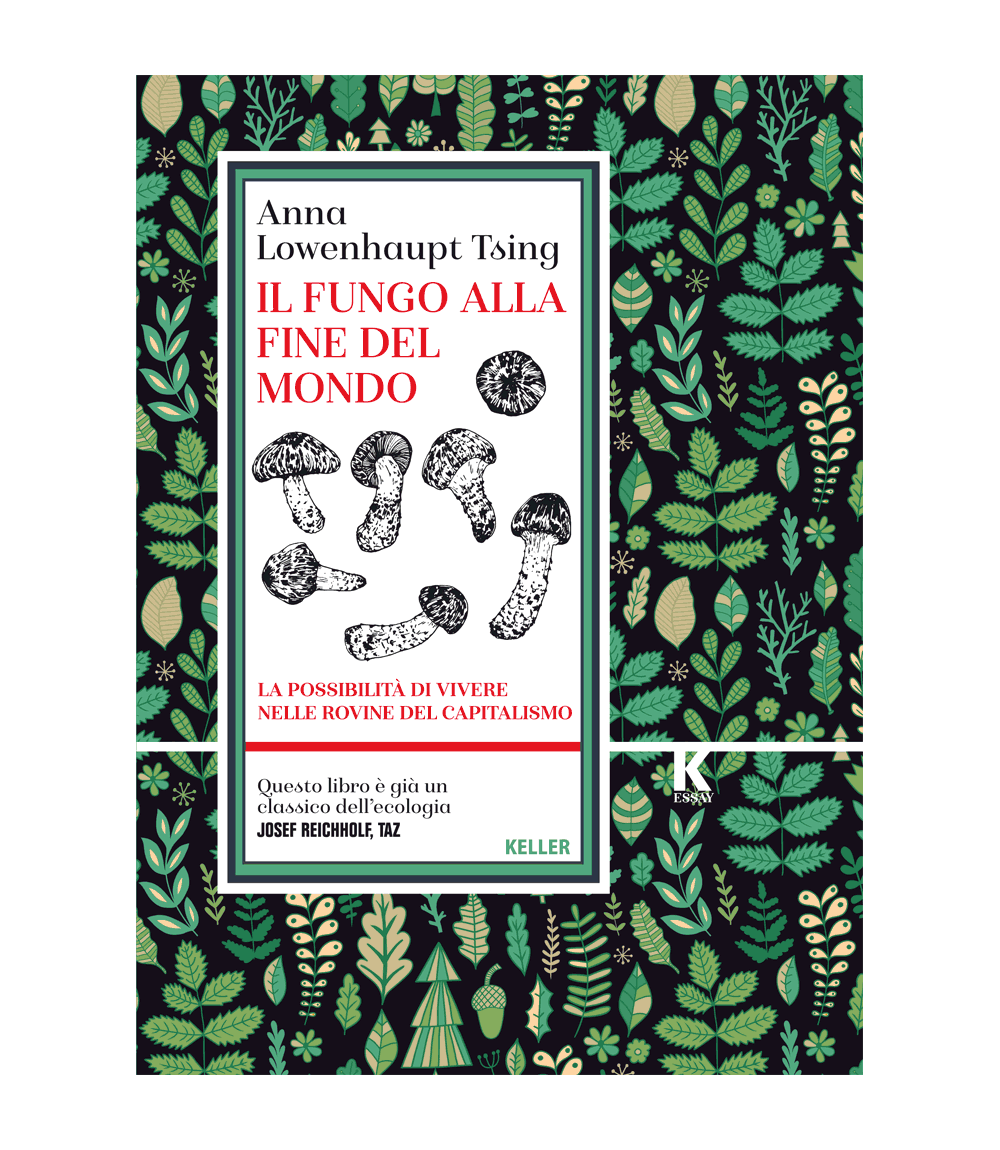
I probably agree with this person, but the prose is frustrating, meandering, aimless gibberish.
"But this is how mushrooms experience the world"? Yeah, well I'm not a fucking mushroom, am I?
God.
1) "What do you do when your world starts to fall apart? I go for a walk, and if I'm really lucky, I find mushrooms. Mushrooms pull me back into my senses, not just—like flowers—through their riotous colors and smells but because they pop up unexpectedly, reminding me of the good fortune of just happening to be there. Then I know that there are still pleasures amidst the terrors of indeterminacy."
2) "Matsutake are wild mushrooms that live in human-disturbed forests. Like rats, raccoons, and cockroaches, they are willing to put up with some of the environmental messes humans have made. Yet they are not pests; they are valuable gourmet treats—at least in Japan, where high prices sometimes make matsutake the most valuable mushroom on earth. Through their ability to nurture trees, matsutake help forests grow in daunting places. To follow matsutake guides us to possibilities of coexistence within environmental disturbance. This is not an excuse for further damage. Still, matsutake show one kind of collaborative survival."
3) "For living things, species identities are a place to begin, but they are not enough: ways of being are emergent effects of encounters."
4) "[Contaminated] diversity is recalcitrant to the kind of 'summing up' that has become the hallmark of modern knowledge. Contaminated diversity is not only particular and historical, ever changing, but also relational. It has no self-contained units; its units are encounter-based collaborations. Without self-contained units, it is impossible to compute costs and benefits, or functionality, to any 'one' involved. No self-contained individuals or groups assure their self-interests oblivious to the encounter. Without algorithms based on self-containment, scholars and policymakers might have to learn something about the cultural and natural histories at stake. That takes time, and too much time, perhaps, for those who dream of grasping the whole in an equation. But who put them in charge?"
5) "Freedom/haunting: two sides of the same experience. Conjuring a future full of pasts, a ghost-ridden freedom is both a way to move on and a way to remember. In its fever, picking escapes the separation of persons and things so dear to industrial production. The mushrooms are not yet alienated commodities; they are effects of the pickers' freedom. Yet this scene only exists because the two-sided experience has purchase in a strange sort of commerce. Buyers translate freedom trophies into trade through dramatic performances of 'free market competition.' Thus market freedom enters freedom's jumble, making the holding in abeyance of concentrated power, labor, property, and alienation seem strong and effective."
6) "Can matsutake as an economic product be managed sustainably? This question takes shape within the history of Forest Service efforts at timber management. In this history, nontimber forest products cannot be seen unless they make themselves compatible with timber. Thus the stand—the unit of manageable timber—is the basic landscape unit U.S. foresters can see. The fungal patch ecologies studied by Japanese scientists just do not register on this grid. The scale of U.S. forestry research on matsutake is adjusted accordingly. Some studies use random transects to sample matsutake on a scale that is compatible with timber stands. Others build models through which fungal patches can be scaled up. These studies devise monitoring techniques to make matsutake visible on the scale of timber's rationalization."
7) "To find a good mushroom, I need all my senses. For there is a secret to matsutake mushroom picking: one rarely looks for mushrooms."
8) "Sometimes common entanglements emerge not from human plans but despite them. It is not even the undoing of plans, but rather the unaccounted for in their doing that offers possibilities for elusive moments of living in common. This is the case for the making of private assets. Assembling assets, we ignore the common—even when it pervades the assembly. Yet the unnoticed, too, can be a site for potential allies."
9) "Bosses are embodiments of the entrepreneurial spirit. In contrast to earlier socialist dreams, they are supposed to make themselves, not their communities, wealthy. They dream of themselves as self-made men. Yet their autonomous selves bear comparison to matsutake mushrooms: the visible fruit of unrecognized, elusive, and ephemeral commons."