
Interessant, aber.
3.0 stars
Im großen und ganzen ein interessantes und gut lesbar geschriebenes Buch. Allerdings stört mich , dass der Autor sagt "Das ist so", während es eigentlich heißen müsste: "Wahrscheinlich ist es so.".
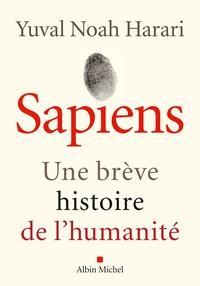
Il y a 100 000 ans, la Terre était habitée par au moins six espèces différentes d'hominidés. Une seule a survécu. Nous, les Homo Sapiens. Comment notre espèce a-t-elle réussi à dominer la planète ? Pourquoi nos ancêtres ont-ils uni leurs forces pour créer villes et royaumes ? Comment en sommes-nous arrivés à créer les concepts de religion, de nation, de droits de l'homme ? A dépendre de l'argent, des livres et des lois ? A devenir esclaves de la bureaucratie, des horaires, de la consommation de masse ? Et …
Il y a 100 000 ans, la Terre était habitée par au moins six espèces différentes d'hominidés. Une seule a survécu. Nous, les Homo Sapiens. Comment notre espèce a-t-elle réussi à dominer la planète ? Pourquoi nos ancêtres ont-ils uni leurs forces pour créer villes et royaumes ? Comment en sommes-nous arrivés à créer les concepts de religion, de nation, de droits de l'homme ? A dépendre de l'argent, des livres et des lois ? A devenir esclaves de la bureaucratie, des horaires, de la consommation de masse ? Et à quoi ressemblera notre monde dans le millénaire à venir ?
Véritable phénomène d'édition, traduit dans une trentaine de langues, Sapiens est un livre audacieux, érudit et provocateur. Professeur d'Histoire à l'Université hébraïque de Jérusalem, Yuval Noah Harari mêle l'Histoire à la Science pour remettre en cause tout ce que nous pensions savoir sur l'humanité : nos pensées, nos actes, notre héritage... et notre futur.
grand format, 501 pages
French language
Published Sept. 2, 2015 by Albin Michel.
Im großen und ganzen ein interessantes und gut lesbar geschriebenes Buch. Allerdings stört mich , dass der Autor sagt "Das ist so", während es eigentlich heißen müsste: "Wahrscheinlich ist es so.".
While reading through the last chapter, I recognize that Harari is himself a victim to the myths he so often talks about in the course of the book. The final pages of the book read like an advertisement for a venture-capital funded artificial intelligence startup that promises the future, while only caring about its owner's short-term wealth accumulation.
The core thesis that you are able to take away from this book, should you choose to do so, is that human societies and connections that go beyond the simple rural village or family clan require shared myths.
Harari calls everything a "myth" that doesn't exist in nature but is man-made. Be that religious beliefs, societal roles, money, the rule of law, a belief in individuality and human rights, capitalism, communism, and everything in between.
He manages to hold a position that calls religious beliefs an arbitrary invention, while …
While reading through the last chapter, I recognize that Harari is himself a victim to the myths he so often talks about in the course of the book. The final pages of the book read like an advertisement for a venture-capital funded artificial intelligence startup that promises the future, while only caring about its owner's short-term wealth accumulation.
The core thesis that you are able to take away from this book, should you choose to do so, is that human societies and connections that go beyond the simple rural village or family clan require shared myths.
Harari calls everything a "myth" that doesn't exist in nature but is man-made. Be that religious beliefs, societal roles, money, the rule of law, a belief in individuality and human rights, capitalism, communism, and everything in between.
He manages to hold a position that calls religious beliefs an arbitrary invention, while simultaneously slamming militant atheists for rejecting religious beliefs wholesale because the atheist, too, shares beliefs (individualism, secularism, human rights, whatever you wish) that are ultimately cultural and made up by humans.
He attributes the fact that modern ideologies like capitalism, communism, imperialism, national socialism or feminism are not religions in a literal sense to medical progress and the reduction in child mortality in the modern era. If death is no longer a constant surrounding factor in your life, the capitalist, communist or feminist does not need to worry about promises of the afterlife, he says.
Another core observation he makes is that belief and hope in a better future did not necessarily exist in the Middle Ages and before in the way it does now. He says that pre-modern ideologies share the belief that the world is getting worse all the time, and the only way to make it better is to return to the golden age of the mythical past. Whereas a modern company manager cares to disrupt markets, the ancient priest thus saw heresy, the deliberate change of a prior-held belief, as sinful.
And he is not suggesting that this "progress" is a good thing, necessarily. He highlights at lengths how scientific progress in the age of "discovery" came hand-in-hand with the imperialist conquest of the world. You could say that the scientific progress of the past 500 years and our positive or optimistic views of the future are an unintentional side-effect of imperial conquest. At least, with the concepts Harari describes, this is a possible conclusion.
I really don't know what I think about this book and Harari's ideas in the end. I wonder how this book's conclusion would have looked like if it was written in the spring of 2025. Would he still postulate that soon humanity will create general artificial intelligence, androids, and genetically engineered superhumans?
Lots to think about... I loved some of it, and many of the ideas presented made me question my outlook of the world! He also, however, threw a few curved balls, and let myth sit as fact in places. One of my favourite stories from the book, the one about Buzz Aldrin and the Native American, looks to be a myth for example. Other sections just didn't come to much (the chapter on gender for example, although it was written 2011 and these debates develop quickly). It is interesting to see how the book has aged... sometimes well, sometimes not so much. Overall worth the read, and helpful for reflecting on these things.
Das Buch war sehr interessant. Ich habe zwar aus irgendeinem Grund sehr lange gebraucht, um das Buch zu lesen, aber es ist definitiv empfehlenswert.
Was an excellent book except for the part about the agricultural revolution
A gentle expansion of your world view, this book will help you see human history in a whole new light. Is Buddhism a religion or an ideology? Is money real, or a part of our collective imagination? Who are we? Who do we want to become?
Eine absolute Empfehlung für jeden, der sich einigermaßen für die Geschichte und Evolution der Menschheit interessiert. Das Buch liest sich wie ein Krimi und gibt ganz neue Einblicke in diesem spannenden Gebiet.
Bücher über wissenschaftliche Themen können ja verdammt zäh sein. Man fühlt sich manchmal eher wie in einer drögen Vorlesen und nur sehr bedingt unterhalten. Bei Harari ist das völlig anders.
Die Geschichte der Menschheit "kurz" (der Wälzer ist immer noch dick genug) und so lesbar zu beschreiben, dabei aber immer wissenschaftlich fundiert und nachvollziehbar, das ist schon eine Meisterleistung. Man versteht auch sofort, woher einige Entwicklungen der Menschheit kommen, ohne sich dabei belehrt zu fühlen.
Eine absolute Empfehlung. Vielleicht nichts für die ganz jungen und (die meisten) Teens, aber Jugendlich und alle Erwachsenen sollten das Buch ganz dringend lesen.