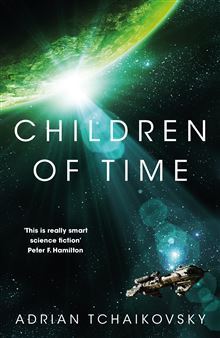
Children of Time is a 2015 science fiction novel by author Adrian Tchaikovsky. The work was praised by the Financial Times for "tackling big themes—gods, messiahs, artificial intelligence, alienness—with brio."It was selected from a shortlist of six works and a total pool of 113 books to be awarded the Arthur C. Clarke Award for best science fiction of the year in August 2016. The director of the award program said that the novel has a "universal scale and sense of wonder reminiscent of Clarke himself."In July 2017, the rights were …
Children of Time is a 2015 science fiction novel by author Adrian Tchaikovsky.
The work was praised by the Financial Times for "tackling big themes—gods, messiahs, artificial intelligence, alienness—with brio."It was selected from a shortlist of six works and a total pool of 113 books to be awarded the Arthur C. Clarke Award for best science fiction of the year in August 2016. The director of the award program said that the novel has a "universal scale and sense of wonder reminiscent of Clarke himself."In July 2017, the rights were optioned for a potential film adaptation.A sequel, Children of Ruin, was published in 2019.
Set across thousands of years, it nevertheless reads through without feeling stretched. It follows two threads. The first is the story of uplifting a species. The second is the far-off descendants of those who started the uplift. Themes of the nature of humanity and the drive for survival.
As a life-long arachnophobe, Tchaikovsy did something I honestly never thought could happen. He made me pull for an arachnid species. He wrote them in such an empathetic way. He had me rooting for them and their species. If the movie is ever made, though, I'm NOT going to see it.
I liked the parallels he maintained between the two story lines. And I really enjoyed the gender flip on oppression for the spiders. Of course the male spiders were lower ranked in society. It was a bit heavy-handed at times, but maybe that'll just help men who don't get it now see it.
Very intriguing story and great world-building on the green planet. I was really fascinated by the cities and technologies made from silk.
But I never felt too much sympathy with the protagonists, because they either only came up for a short period and then disappeared in time, repeating the same names (Portia) for different characters didn't help. Or because they were not very likeable. There was hardly any backstory on the crew of the ship, and emotional storylines like the relationship of classicist and engineer were rather subdued, never made it into my heart. The storyline was foreseeable in many parts, even the rather abrupt ending. I found myself skipping lines and paragraphs towards the end.
This may sound negative, and honestly, the book leaves me somehow unsatisfied, even though I can't point out a singular reason. Nevertheless, I would recommend reading it, it's entertaining and gripping in …
Very intriguing story and great world-building on the green planet. I was really fascinated by the cities and technologies made from silk.
But I never felt too much sympathy with the protagonists, because they either only came up for a short period and then disappeared in time, repeating the same names (Portia) for different characters didn't help. Or because they were not very likeable. There was hardly any backstory on the crew of the ship, and emotional storylines like the relationship of classicist and engineer were rather subdued, never made it into my heart.
The storyline was foreseeable in many parts, even the rather abrupt ending. I found myself skipping lines and paragraphs towards the end.
This may sound negative, and honestly, the book leaves me somehow unsatisfied, even though I can't point out a singular reason. Nevertheless, I would recommend reading it, it's entertaining and gripping in most parts, and as said before, the world-building is full of original, great ideas.
Incredible! "The smartest evolutionary world-building you'll ever read", indeed! I was not expecting that wonderful ending. I was bracing myself for an ending I would not like, but I was wrong!